Consumer messaging applications frequently tout software end-to-end encryption, but in hostile physical operating environments, the underlying host smartphone operating system remains vulnerable to baseband vulnerabilities and hardware keystroke side-channels. Hardened tactical voice architecture relies on dedicated, air-gapped cryptographic hardware modules.
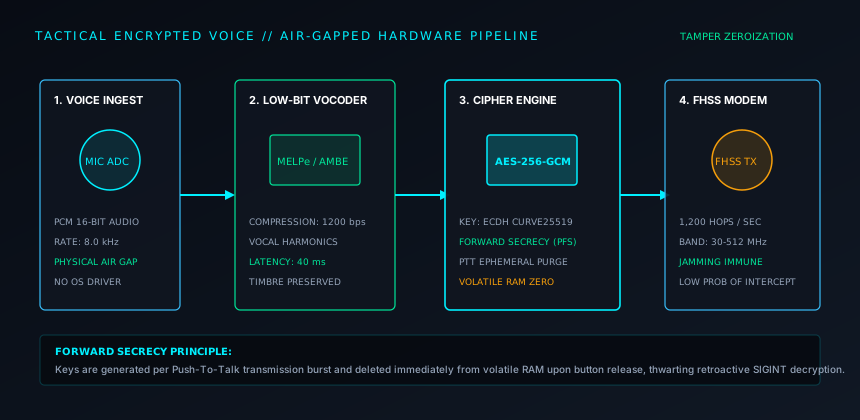
1. Dedicated Cryptographic Hardware vs. Consumer Software
Tactical hardware cryptographic voice solutions isolate all audio digitizing and cryptographic math onto dedicated, tamper-resistant microcontrollers running verified bare-metal firmware without external OS dependencies:
- Zero-Remanence RAM Architecture: Crypto keys are held exclusively in volatile static RAM backed by anti-tamper encapsulation meshes. If the chassis is pierced, opened, or subject to voltage fluctuations, internal capacitive circuitry instantly zeroizes all cryptographic material within nanoseconds.
- Galvanic Baseband Isolation: The microphone audio is converted to a digital stream, compressed, and encrypted before reaching the cellular modem or radio transmitter. The baseband modem operates strictly as an untrusted pipe, processing only opaque binary ciphertext.
2. Low-Bitrate Vocoder Compression Architectures
Transmitting real-time encrypted voice across constrained, noisy radio channels requires reducing spoken audio to the lowest possible data bitrate without destroying human voice intelligibility:
| Vocoder Algorithm | Channel Bitrate | Acoustic Intelligibility | Latency Profile |
|---|---|---|---|
| MELPe (STANAG 4591) | 1200 / 2400 bps | High (Preserves vocal timbre and speaker recognition) | 40–60 ms processing buffer |
| AMBE+2 | 2000 to 4800 bps | Exceptional (Standard across digital mobile radio DMR) | 20–35 ms processing buffer |
| Standard PCM (G.711) | 64,000 bps | Pristine (Standard landline telephone fidelity) | < 5 ms (Requires massive RF bandwidth) |
By compressing vocal harmonics down to 1200 or 2400 bits per second, the encrypted ciphertext payload can easily be transmitted across narrow HF bands, legacy VHF tactical links, or satellite data terminals without requiring broadband connections.
3. Ephemeral Key Agreement & Perfect Forward Secrecy (PFS)
A critical architectural flaw in legacy scramblers was the use of static shared encryption keys flashed onto radios prior to a mission. If an operator was captured and their radio extracted, opposing signals intelligence units could retroactively decrypt weeks of recorded radio traffic.
Modern voice encryption units incorporate Ephemeral Elliptic-Curve Diffie-Hellman (ECDH) key exchanges on every single Push-To-Talk (PTT) session:
- At the start of the transmission, both transceivers exchange 32-byte ephemeral public keys across the preamble data burst (taking approximately 80 milliseconds).
- Each device computes a shared secret session key independently using Curve25519 or NIST P-384.
- The voice transmission is encrypted with an authenticated cipher mode (such as AES-256-GCM or ChaCha20-Poly1305).
- Upon releasing the PTT button, both radios erase the ephemeral session key from memory. Even if an adversary captures the hardware moments later, past recorded voice intercepts remain mathematically unrecoverable.
4. Frequency-Hopping Spread Spectrum (FHSS) Anti-Jamming
Encryption shields message contents, but it does not prevent an adversary from jamming the radio frequency or detecting the physical presence of the transmitter using direction-finding (DF) antenna arrays.
To counteract physical RF intercept and electronic warfare jamming, military and executive security transceivers utilize Frequency-Hopping Spread Spectrum (FHSS). The transmitter rapidly changes its center carrier frequency across a broad radio band (e.g., 30 MHz to 512 MHz) between 500 and 1,200 times per second according to a pseudo-random sequence shared only with synchronized team receivers. An observer monitoring a single frequency hears only microscopic, unrecognizable millisecond pops of noise, completely defeating narrowband tracking receivers and conventional electronic jamming transmitters.
5. Vulnerability and Risk Analysis
Hardened Crypto Strengths
- Mathematical immunity to real-time brute-force decryption attacks.
- Protection against carrier-level lawful intercept and IMSI-catchers.
- Complete isolation from software vulnerabilities in commercial smartphones.
- Instant key zeroization upon physical chassis breach detection.
Operational Trade-Offs
- Acoustic latency of 150–250 ms inherent in vocoder buffer processing.
- Requires strict operational discipline to manage initial key bootstrapping.
- Possession of specialized hardware can attract physical search scrutiny.
- Vulnerable to direct room-level acoustic eavesdropping at the speaker's mouth.
6. Protocol Implementation Recommendations
True communication security requires end-to-end discipline. Even an uncrackable 256-bit encrypted radio channel is useless if spoken words are picked up by an unshielded room microphone in the user's environment. Hardened voice solutions must always be paired with physical acoustic boundary shields and strict compartmentalization protocols.