Technical Surveillance Counter-Measures (TSCM) is the science of locating, identifying, and neutralizing illicit observation hardware. Rather than relying on simple consumer "bug finders," professional physical security operators deploy a layered multi-technology methodology to detect active, dormant, and completely powered-down threats.
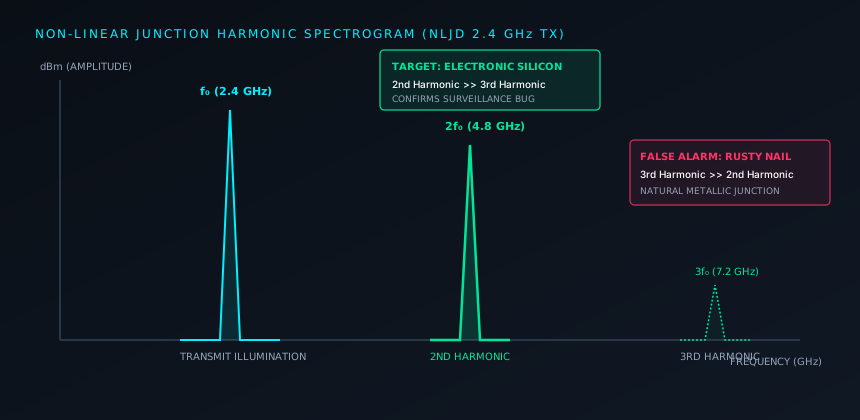
1. The Non-Linear Junction Detector (NLJD)
The most critical tool for finding inert, inactive, or unpowered electronic bugs is the Non-Linear Junction Detector. All modern electronic devices—whether active, asleep, or broken—contain semiconductor components made of silicon (diodes, transistors, microprocessors).
When illuminated by a clean, high-frequency microwave transmission (typically in the 2.4 GHz or 800 MHz ISM bands), semiconductor p-n junctions behave non-linearly. The junction reflects back the transmitted signal, but re-radiates it at exact harmonic multiples of the fundamental frequency:
- Second Harmonic (2f): When the microwave pulse strikes an artificial semiconductor junction (silicon, gallium arsenide), it reflects strongly at twice the base frequency (e.g., 4.8 GHz).
- Third Harmonic (3f): When the microwave pulse strikes a natural junction—such as two dissimilar metals in contact or rusty nail oxidation within drywall—the energy reflects predominantly at three times the base frequency (e.g., 7.2 GHz).
By comparing the relative signal strength between the received 2nd and 3rd harmonics, an NLJD operator can differentiate between a semiconductor bug hidden deep inside a wooden wall and a harmless drywall screw, even if the bug has run out of battery or was switched off remotely.
2. Optical Retro-Reflective Lens Locators
While an NLJD locates semiconductor silicon, optical sweepers exploit physical reflection laws. A camera pinhole lens may be less than a millimeter in diameter, but the focal plane beneath it consists of a reflective silicon image sensor.
Optical lens finders project an array of ultra-bright pulsed red laser or LED light beams aligned co-axially with an optical viewing port or viewfinder. When the pulsed light strikes the curved glass optics of a hidden camera, the retro-reflective principle dictates that the light reflects directly back along the exact axis of incidence. Through the viewing filter, the operator sees a distinct, flashing, bright red pinpoint of light pinpointing the exact location of the hidden camera lens, regardless of whether the camera is turned on, powered down, or battery-dead.
3. High-Speed RF Spectrum Analyzers & Near-Field Receivers
For locating live transmitters, swept spectrum analyzers provide continuous visual representations of local electromagnetic activity across frequencies up to 24 GHz. Professional TSCM methodology utilizes two distinct RF detection modes:
| Technology Type | Primary Use Case | Target Signature | Operational Constraint |
|---|---|---|---|
| Swept Spectrum Analyzer | Far-field spectral mapping | Persistent carriers, frequency hopping | Requires baseline RF profile of the local ambient environment. |
| Near-Field Broadband Probe | Close-proximity localized pinpointing | High-amplitude near-field RF leakage | Requires physically scanning within 10–30 cm of walls and furniture. |
| Demodulating Receiver | Audio verification of analog signals | AM/FM/WFM demodulated audio tone | Cannot demodulate modern encrypted or digitally modulated data streams. |
| Time-Domain Reflectometer (TDR) | Inspection of copper wire pairs | Impedance anomalies on mains/phone lines | Limited to physical conductors and physical cable runs. |
4. Establishing the RF Ambient Baseline
A common mistake during physical sweeps is misidentifying authorized local transmissions (such as municipal broadcast towers, nearby cellular base stations, and commercial air traffic beacons) as hostile listening devices.
A sound counter-surveillance sweep begins by capturing a baseline RF signature 50 to 100 meters outside the target secure perimeter. This ambient profile is stored as an electronic reference mask. When the sweep team enters the target room, the analyzer automatically subtracts the external baseline mask from the internal readings. Any signal present inside the room that does not appear in the external baseline is immediately isolated for near-field investigation.
5. Comparison: Consumer Detectors vs. Tactical TSCM Suites
Tactical TSCM Instrumentation
- Harmonic differentiation isolates semiconductors from structural rust.
- Co-axial laser optical finders detect non-transmitting pinhole lenses.
- High-speed sweeping catches short-duration microsecond burst signals.
- Differential baseline subtraction filters external commercial broadcasts.
Consumer "All-in-One" Bugs Finders
- Simple broadband antennas trigger false positives on every nearby Wi-Fi router.
- Complete inability to detect dormant, scheduled, or hardwired listening devices.
- No harmonic differentiation; cannot separate silicon chips from metal nails.
- Limited dynamic range masks weak low-power signals behind commercial cellular noise.
6. Comprehensive Inspection Protocol
A complete TSCM inspection is never a single sweep. It requires a systematic physical search, an optical retro-reflective sweep, a thermal gradient evaluation, high-speed radio spectrum differential baselining, and non-linear junction testing of all furniture, walls, ductwork, and electrical outlets within the secure facility.